There is a particular kind of warmth you only find in a good pub. Not just the literal warmth of a proper fire, or the comfort of a familiar bar and a friendly face, but the warmth of continuity: the sense that what happened here yesterday matters, and what happens here tomorrow will matter too.
A pub is more than a “boozer”, more than a place that sells drinks. It is a community’s living room. It is where friendships begin and end, where families mark milestones, where people test out new ideas, make plans, nurse heartbreaks, celebrate wins, settle into routines, and — just as importantly, maybe now more than ever — feel less alone. When you multiply that by decades, sometimes centuries, you start to grasp what pubs really hold.
And, to me, that is why the loss of pubs cuts so deeply.
Snow Hill, Dudley Street, and what we can’t get back
If I had a time machine, I would set the dial for old Snow Hill — before the arrival of the Wulfrun Centre and the wider city-centre redevelopment that reshaped Wolverhampton in the late 1960s.
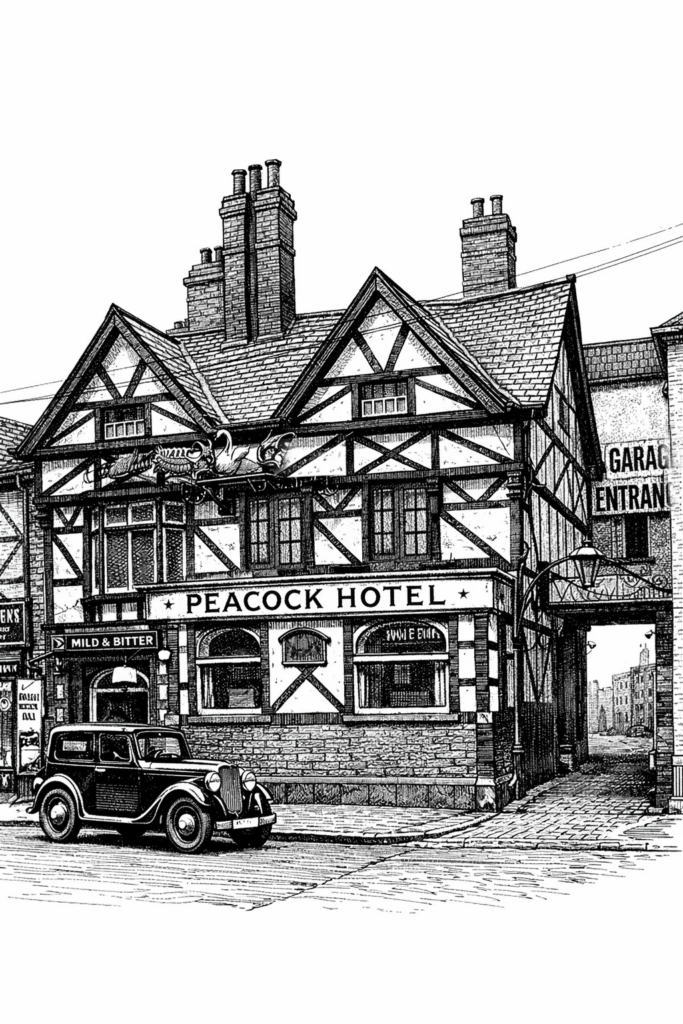
I would walk those streets with no other agenda than to step into the pubs that are now gone: places like the Swan and Peacock, the Hen and Chickens, the Fleece (aka Bodega) and the others that clustered around Snow Hill and Dudley Street. For those who know their Wolverhampton pub history, even the names carry a charge — because they are more than names. They are doors that no longer open.
How many have we lost on Dudley Street alone? And how many of those losses are now not merely “closed”, but effectively erased, the building torn down and replaced?
What saddens me most is that for a lot of those old pubs, they are completely lost to time. We might have a photograph of a frontage if we’re lucky.
We might have a street scene. But inside? The interiors — the heart of the place — often vanished without trace.
No casual snapshots. Times long before phone cameras. For the majority of people, there was no habit of documenting everyday life. Just decades of lived experience, and then… nothing.
For me that absence creates a strange kind of grief. Because when a pub disappears, it isn’t only bricks and beer pumps that go. It is tens — sometimes hundreds — of years of laughter, love, tears, planning, plotting, friendships, fallings-out, first dates, last drinks, and stories told so many times they became part of the furniture. All of that human energy is dispersed. The room where it happened is gone. The acoustics of it, the smell of the timber, the furniture, the corners people favoured — all gone. Never to be felt again in the way it was.
My First Pub - The Grapevine (aka The Vine)
My own relationship with pubs isn’t abstract or academic (though I enjoy writing about them, I much prefer to live them!). Like many of you reading this, it’s personal.
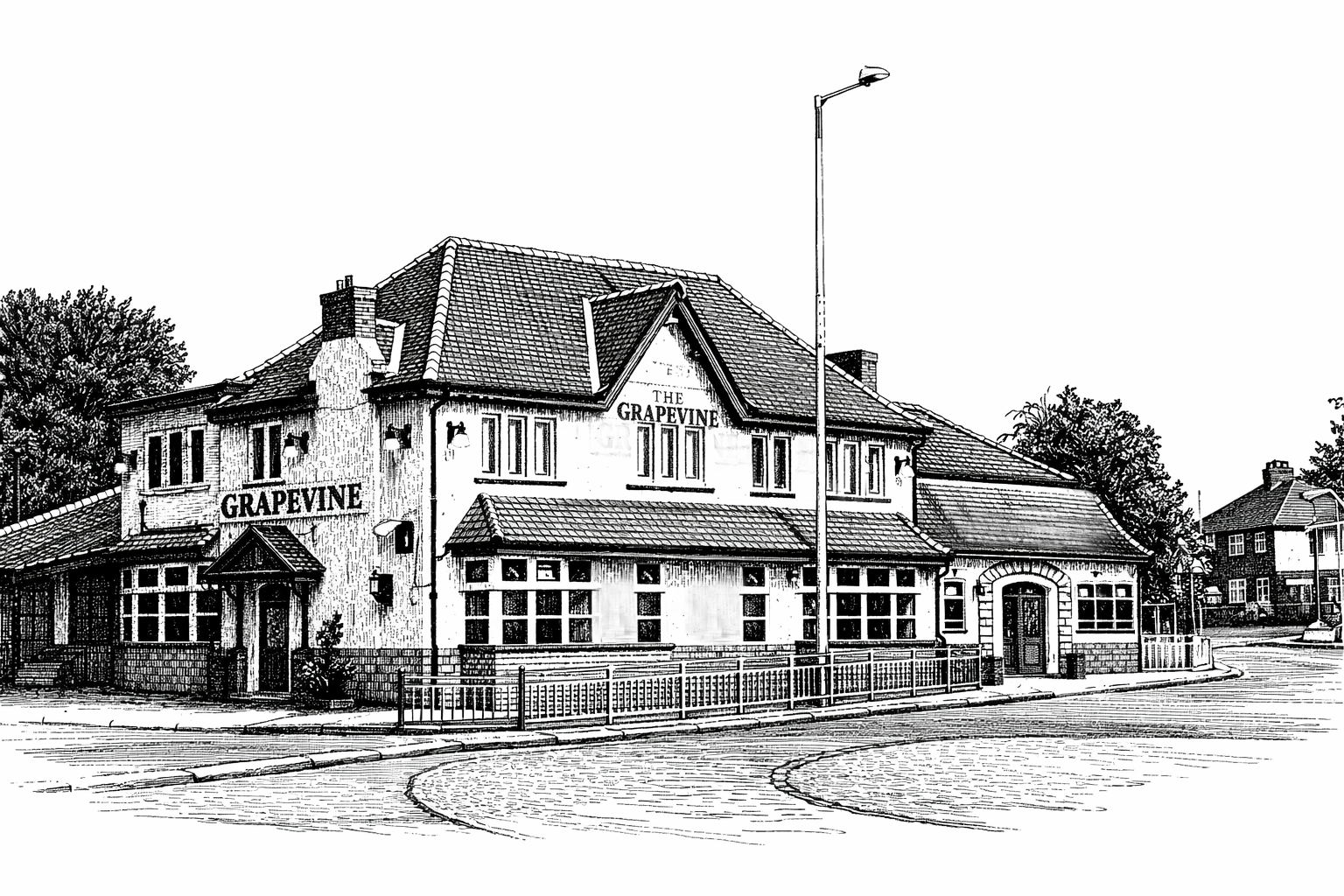
My first pub was the Grapevine — we always called it The Vine — on what is still often called Vine Island at Wobaston on the Stafford Road. I had many a good (and on the odd occasion, bad) weekend evening at the Vine. Fun times with friends, a DJ and lots of beer. Today the site is housing. I remember that sense of finality when it went. Coming past to see the roof tiles had gone. And then, a place that felt permanent, suddenly not there. (In early 2004, redevelopment proposals explicitly involved the demolition of the pub and its car park for housing — and that tells its own story about the pressures pubs face when land values speak louder than community value.)
That may sound like nostalgia, and it is – personal nostalgia but surely shared. It is also more than that: recognition that pubs carry a portion of our personal history, and that when they go, parts of our story become harder to locate. We can still remember — but we can’t return to the room where it happened. And in time, with us, that memory is also gone.

One I never got to visit: the Elephant & Castle
There is another pub loss that has always stayed with me: the Elephant & Castle, on the corner of Stafford Street and Cannock Road.
I always wanted to visit it. I never got the chance. Many a time on the bus to college around 1999, I’d pass the Elephant & Castle – when in traffic at the Cannock Road junction heading into the then town centre, I’d marvel through the window at the design of the pub, its tiles and in particular the iconic elephant statue on the corner catching the eye of the curious.
Built in 1905, and replacing an earlier Elephant & Castle, it was demolished in 2001 — and not in the slow, inevitable way that allows people a final visit, a last look, a final pint and goodbye. It was knocked down on a Sunday, “overnight”, controversially and abruptly. The anger and resentment from that lives on, even now a quarter of a century later.
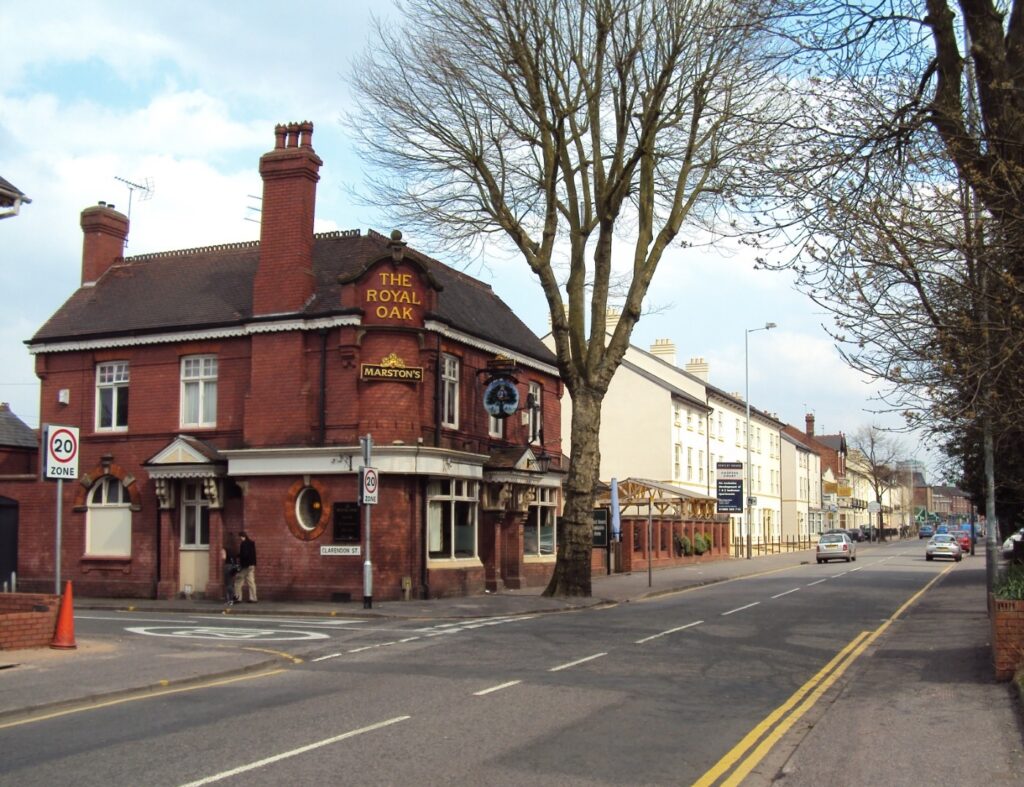
This month, I’ve been chatting with Terry Cole over at the Royal Oak at Chapel Ash, on the Compton Road. That pub was rebuilt (there was an earlier Royal Oak on the same site) around the same time as the Elephant & Castle was and is thankfully still there, standing proud in its Edwardian splendour. Terry has maps, photographs, a history wall inside the pub and is planning on celebrating the 120th year of the Royal Oak this year. But like all good pubs – will it survive whatever comes next? We’re looking at very difficult times for our pubs and clubs.
Looking back to the Elephant & Castle, there is some comfort, of course, in knowing we can visit a faithful recreation at the Black Country Living Museum, where the pub has been brought back as part of their 1940s–60s town experience. That matters — and it is worth celebrating. I’m yet to visit, though I know some of my fellow CAMRA members have been. In a weird way, I want it to feel lived in, not smelling of fresh paint. As close to the old pub as possible.
But a replica, however brilliant, is still a reminder of what has been taken away from the living city. It prompts a question that should trouble all of us:
Must our pubs be relics in a museum?
Pubs are not a quirky footnote in British life. They are one of its foundations, a real hallmark of our culture. I’d go as far as to say that we would be different, had the pubs not shaped us as much as we’d shaped them over the centuries. They are part of us, we are part of them.
From the mead hall to the coaching inn, from industrial beerhouses to the modern local — this is a thread that runs through our culture. Pubs have always been places where communities organise themselves. Where news travels. Where help is offered quietly. Where traditions persist long after fashions change. My early time in pubs gave me a good insight into the minds of my parents and grandparents, because it was what they had lived. Traditional, comfortable. A home away from home.
When a pub closes, it often looks — on paper — like “one fewer venue”. We at CAMRA track it carefully and often discuss those places we used to frequent. The hard, sad truth is, when we lose a pub, it can mean one fewer anchor point for an area; one fewer place where different ages and backgrounds mix; one fewer informal support network. Just one less place between home and work where people can simply be.
That is a huge part of why CAMRA exists. Not because we want to lock pubs away in amber, but because we understand their value while they are still alive — and we want them to remain part of everyday life. I don’t want to use this as a cheap “join CAMRA, save pubs” piece; if you’re here, you likely already care and you’re probably a CAMRA member. But yes – if you haven’t, consider joining. We can — and do — make a difference.
A request to Wolverhampton: help us recover what’s been lost
This is where I’d love to get your help.
If you are reading this and you remember these pubs — the many on Snow Hill and Dudley Street, The Vine, the Elephant & Castle, and countless others throughout Wolverhampton — I would like to hear from you. You’ll notice that I don’t mention much about the ale, the cider or any other drink available at pubs here. This article is about the places themselves, as important as types of beer and methods of dispense are to us at CAMRA.
What does it matter if the pub doesn’t exist in the first place? In the first instance, pubs have always been places to meet and many of you will have personal memories of these places.
Though – we’re looking for not only your memories (though those matter deeply), but your materials:
- Photographs of pub interiors, even if they’re informal or imperfect
- Pictures from family events, darts teams, dominos nights, Christmas dos, karaoke, anniversaries
- Pub signs, beer mats, flyers, membership cards, posters, programmes, anything with a date and a name
- Stories: short anecdotes are fine; long recollections are even better
- Names of landlords/landladies, regulars, bar staff, teams, and the little details that make a pub a pub

If you have old photos and worry about posting originals, we can work with scans or high-quality phone pictures. If you can scan, 300dpi is a good baseline. If you can’t, a well-lit photo taken straight-on will still help.
Just as important: if you share something, we will want to credit you properly and respect rights and permissions. We can’t build a public archive or produce materials on “borrowed” images without consent — but with consent, we can preserve something that is otherwise disappearing.
So consider this a call to action! If you have memories, photos, or leads, please get in touch with me via email, beerwolf@wolverhampton.camra.org.uk or speak to me at a branch meeting or CAMRA event. Even one photograph of an interior we’ve never seen before can restore a piece of Wolverhampton’s living history.
Remember – pubs are not just places we once drank. They are places where Wolverhampton lived — and, if we fight for them, places where Wolverhampton can keep living.

Cheers!
Neil Hodgkiss
Wolverhampton CAMRA Website Coordinator
West Midlands Campaigner of the Year 2025